By Sassan Kaveh, M.D.
Historical patterns are the best indicator of future behavior. If Americans understood this one sentence, they would understand far more about our politics than most schools and cable news programs will ever explain.
The Question the Reconstruction Era Was Meant to Answer
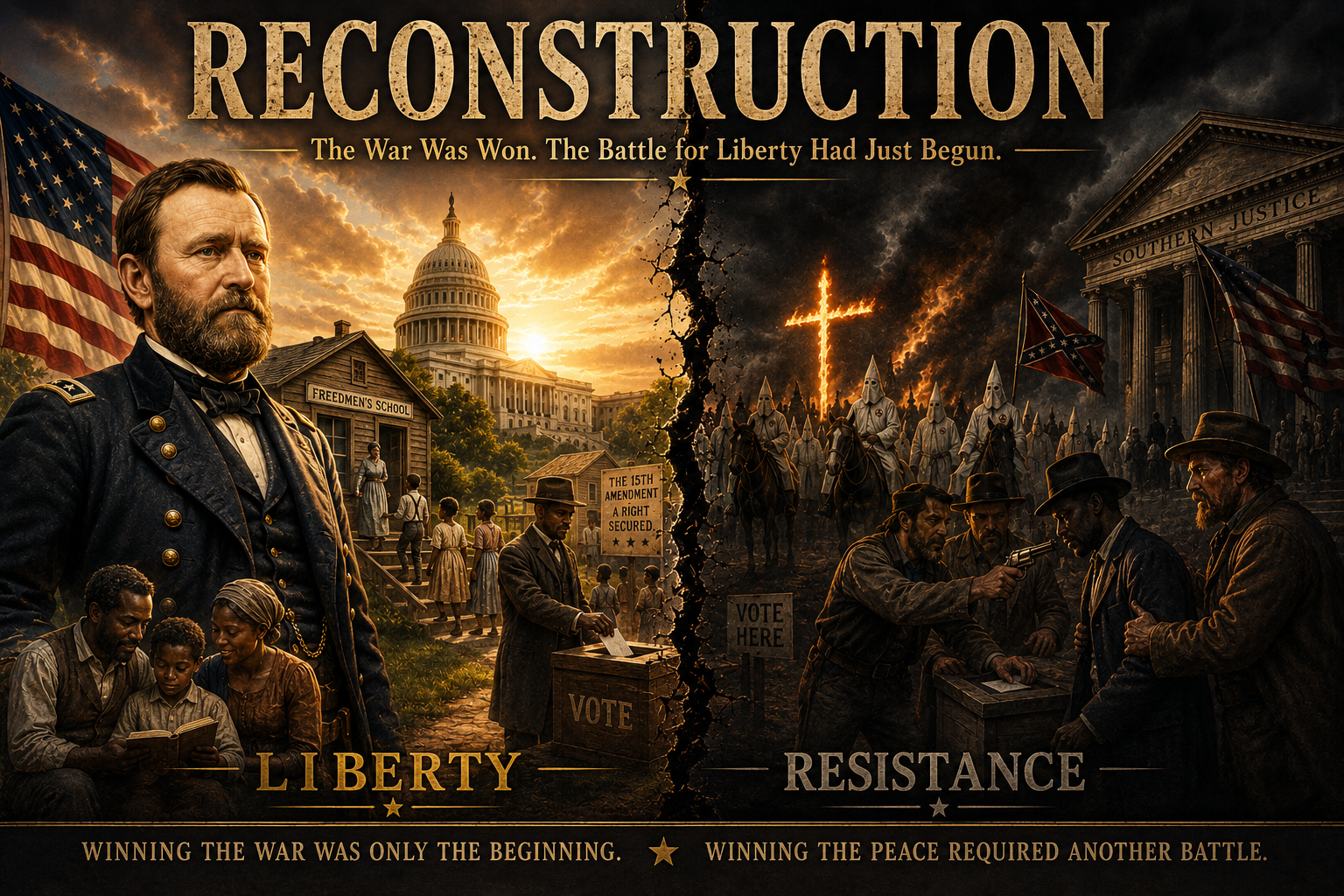
The tumultuous Reconstruction Era stands as a stark testament to the true nature of our contemporary Democratic Party in American history. It was the period right after the Civil War, when America had to answer a basic question: after slavery, after secession, after four years of bloodshed and the sacrifice of hundreds of thousands of lives, would the nation actually become faithful to the promise of liberty? The Republican Party answered yes, but the Democratic Party answered no.
History’s Great Irony: Who Surrendered, and Who Succeeded Lincoln
The Civil War effectively ended on April 9, 1865, when the Confederate General of the Democratic Party, Robert E. Lee, surrendered to the Union General of the Republican Party, Ulysses S. Grant, at Appomattox Court House, Virginia. The party that had defended slavery and led the secession movement had been defeated militarily. One might reasonably expect that the losing party would cease to exist after such a big defeat. At the very least, the losing party would show some reflection, humility, and a sincere effort to rebuild the nation on a new foundation. However, that is not what happened. To understand why, we must first understand one of history’s greatest ironies.
Lincoln’s Gesture of Good Faith
The Southern Democrats officially seceded from the United States by June 1861. As the President of their newly formed Confederate States of America, they elected Jefferson Davis, a Democratic Senator from Mississippi. He had not only previously served as a Democratic congressional leader in both the House and the Senate but also served as the Secretary of War under the Democratic President Franklin Pierce. As the first Republican US president, Abraham Lincoln selected Andrew Johnson, a Democratic senator from Tennessee, as his running mate for his second term in 1864. Lincoln hoped to demonstrate national unity and reconciliation during wartime. It was a gesture of good faith toward Southern Democrats and a signal that the war was ultimately about preserving the Union and preserving civility for all its citizens.
Then tragedy struck. On April 14, 1865, just 5 days after the Union victory, Lincoln was assassinated by John Wilkes Booth, a democrat and a Confederate sympathizer. This was an act of anger and vitriol that characterizes the Democratic Party even today. This bears an unsettling resemblance to today’s Democrat’s political violence, such as the assassination of Charlie Kirk. The following day, Andrew Johnson became president.
A Squandered Victory
Lincoln had won the war. However, Johnson inherited the glory. Because of his policies, many Republicans soon felt that Johnson was squandering the victory Lincoln had secured. To put this in perspective, suppose the Allied powers during WWII, seeking reconciliation, elevated a seemingly reformed German political figure into a position of authority over postwar reconstruction. Would anyone be surprised if he treated defeated German generals with greater sympathy than those who had just defeated them? Of course not. Human nature and political loyalty do not disappear overnight.
Pardons, Black Codes, and the Klan

Johnson’s Reconstruction policy was remarkably biased toward the defeated South. Nearly all of the former Confederates received presidential pardons from Johnson. Southern states were quickly restored to self-government. Former Confederate leaders reentered political life, and even worse, they formed paramilitary militia arms of the Democratic Party, such as the KKK and the Red Shirts. For example, Nathan Bedford Forest was an infamous Confederate general who was then elected as the first Grand Wizard of the KKK. He then went on to become a delegate to the 1868 DNC convention.
What followed should have alarmed every American who believed the war had settled the question of freedom. Southern governments began passing Black Codes; these laws were designed to restrict the freedom of newly emancipated African Americans and force them back into a labor economy. They criminalized Black individuals for things like unemployment (vagrancy laws) and barred them from owning weapons or renting land.
The Radical Republicans of the Reconstruction Era
This was the moment that gave rise to the so-called Radical Republicans. Today, the word “radical” often carries negative connotations. In the context of the Reconstruction Era, however, it meant something very different. They were defined by their staunch opposition to slavery, advocacy for Black civil rights, and demands for harsh Reconstruction policies for the defeated South. They extended the Freedmen’s Bureau and passed the Civil Rights Act of 1866 and the Reconstruction Act, fundamentally altering the scope of federal authority. When President Johnson vetoed these bills, the Republican-majority Congress famously overrode his vetoes and championed the 14th Amendment, followed later by the 15th Amendment.
Opportunity, Not Dependency: Forty Acres and the Freedmen’s Bureau
Republicans believed that emancipation alone would not guarantee freedom. They understood that a man released from bondage without education, legal protection, employment, or the means to support his family remained vulnerable to poverty and exploitation. So, that’s why their vision for Reconstruction extended beyond ending slavery; it sought to equip the formerly enslaved with the tools necessary to build independent and prosperous lives.
General William Sherman’s Special Field Orders No. 15, which temporarily set aside confiscated coastal lands for settlement by formerly enslaved families, reflected this broader philosophy. He allocated up to 40 acres to each family. Although popularly remembered as “forty acres and a mule,” the “mule” was never part of the written order. Many families later borrowed surplus Army mules, giving rise to the phrase. More importantly, the underlying principle was not government dependency, but economic independence through property ownership and opportunity. Later, the Democratic President, Andrew Johnson, restored much of the confiscated land to former Confederate owners. Thousands of Black families who had settled the land were forced off.
The Freedmen’s Bureau further embodied that same Republicans’ vision. It provided education, legal assistance, medical care, employment support, and other essential resources to former slaves and impoverished Southerners. Originally established by President Abraham Lincoln and the Republican Congress on March 3, 1865, just weeks before the Civil War ended and little more than a month before his own life ended. The Bureau represented the nation’s first large-scale effort to help formerly enslaved Americans become self-sufficient citizens rather than permanent wards of the state. While Republicans sought to create pathways to independence and upward mobility, Democratic efforts repeatedly tried to weaken or dismantle these Reconstruction initiatives. The contrast remains instructive even today: The Republican philosophy is built on opportunity, education, hard work, and self-reliance, the enduring pillars of genuine prosperity and the American Dream. By contrast, the Democratic philosophy has increasingly emphasized expanding long-term government dependency, fostering the illusion of prosperity through government handouts and entitlements rather than empowering individuals to achieve lasting economic independence.
These Radical Republicans believed the South needed to be radically transformed if the promises of liberty and equality were ever to become reality. They understood that winning the war was not enough. The nation also had to win peace, civility, and law and order under the Constitution. The Radical Republicans pushed Congress to take control of Reconstruction. They fought for accountability, as well as civil rights, equal protection under the law, and voting rights for newly freed Americans.
Grant Finishes What Lincoln Started
The disastrous Democratic Presidency of Andrew Johnson led to President Ulysses S. Grant running and winning the White House. As a staunch Republican, he realized that the only way to successfully execute Reconstruction, support the 14th Amendment, and defend the civil rights and voting enfranchisement of freed slaves was to take control of the executive branch himself. As the president, he played a pivotal role in the Reconstruction era by aggressively championing the civil and voting rights of newly freed African Americans. He spearheaded the ratification of the 15th Amendment, established the Department of Justice, used federal troops to dismantle the Ku Klux Klan by 1872, and signed landmark civil rights legislation.
The 1868 Platform: Doubling Down After Defeat
The Democratic Party’s audacious 1868 platform, right after their defeat in the Civil War, called for the abolition of the Freedmen’s Bureau and opposed many of the federal efforts designed to protect the rights of former slaves. Rather than embracing the Reconstruction agenda, the Democratic leaders argued for a rapid restoration of the same pervasive confederacy control and resisted the expanding role of the federal government in protecting civil rights. In other words, despite suffering an unconditional defeat after waging a bloody war against their own fellow Americans, the ruling Democrats continued to double down on stupid. Tragically, this persistence bears a striking resemblance to the modus operandi of Iran’s ruling mullahs, as well as the current Democratic Party.
This historical record raises a larger question. Are political parties best judged by their slogans or by their patterns? That question lies at the heart of my book, Common Sense 2.0, A BBB (A Big Beautiful Book).
The argument is that historical patterns matter because they reveal underlying political instincts. The Democratic elite may change their language. They may change their color. They may even change their cloak. Yet their struggles to achieve authoritarian power for the benefit of their own party machine remain unmistakably in front and center of their agenda.
Many of today’s political debates by the Democratic Party echo earlier conflicts over federal authority, constitutional principles, personal responsibility, public order, cultural norms, and competing visions of liberty. Whether the issue is illegal immigration, pervasive crime, woke education, identity politics, late-term abortions, religious persecution, or the role of subversive government in people’s lives, it is certain that Americans are better off to examine these questions through the lens of history rather than political marketing.
From Jim Crow to Dependency: The Pattern Repeats
It is also quite clear that the political struggle by the Democratic Party following the Civil War was fundamentally about power. Democratic leaders of the era worked aggressively to limit Black political participation even after their defeat by the Reconstruction Amendments. Through disfranchisement mechanisms that emerged as part of the Jim Crow era in the 1890s, laws such as poll taxes, literacy tests, and grandfather clauses were explicitly designed to circumvent the 15th Amendment and strip Black Americans of their newly won voting rights. That’s because Democrats understood that newly freed Americans were not going to support the very party that had opposed their liberation so vehemently.
Today, a similar dynamic can be seen in the pursuit of new voting constituencies. Rather than earning support through common sense and constitutional policies, modern Democrats often seek to create a loyal voting base by encouraging a dependency on government programs and cultivating political loyalty through patronage and handouts. Whether through welfare policies, expansive entitlement programs, or illegal immigration policies that can arguably attract economically vulnerable populations, the underlying objective remains the same: securing and maintaining political power by creating long-term dependence on government rather than fostering individual self-reliance and personal responsibility. After the abolition of slavery and the start of Liberalism, the hard-working, upstanding, and successful citizens became the biggest enemy of the Democratic Party.
The Oldest Machine in American Politics
By the way, the practice of securing political allegiance through patronage and government favors is hardly a novel invention of the modern Democratic Party; it is a thread that has woven itself through the fabric of its history for generations. Democratic Party machines were highly sophisticated institutions that did exactly that with complete impunity. They largely dominated and infiltrated urban and state politics from the 1790s through the 1960s. These decentralized, patronage-driven systems operated city by city, with the most infamous example being New York’s Tammany Hall, which maintained major influence for roughly 170 years. But there were other ones nearly as infamous and powerful, such as the Daley machine in Chicago and other ones in Kansas City and Memphis.
The Lesson of the Reconstruction Era
The lesson of Reconstruction is that even after winning one of the bloodiest wars in American history, freedom did not advance automatically in the South. It advanced only because determined citizens and principled Republican leaders fought tirelessly to secure and defend it, often in the face of fierce resistance from Democratic political elites’ intent on preserving the old order.
The Patriots who fought the Revolutionary War against the aristocratic British Empire, as well as the Radical Republicans of the Civil War, equally understood that preserving liberty required courage, conviction, and a willingness to challenge corrupt and powerful elites and autocrats in power. In each case, the patriots were not successful because they were not necessarily the largest faction. They were successful because they were willing to fight courageously for the principles they believed were essential to the Republic’s welfare.
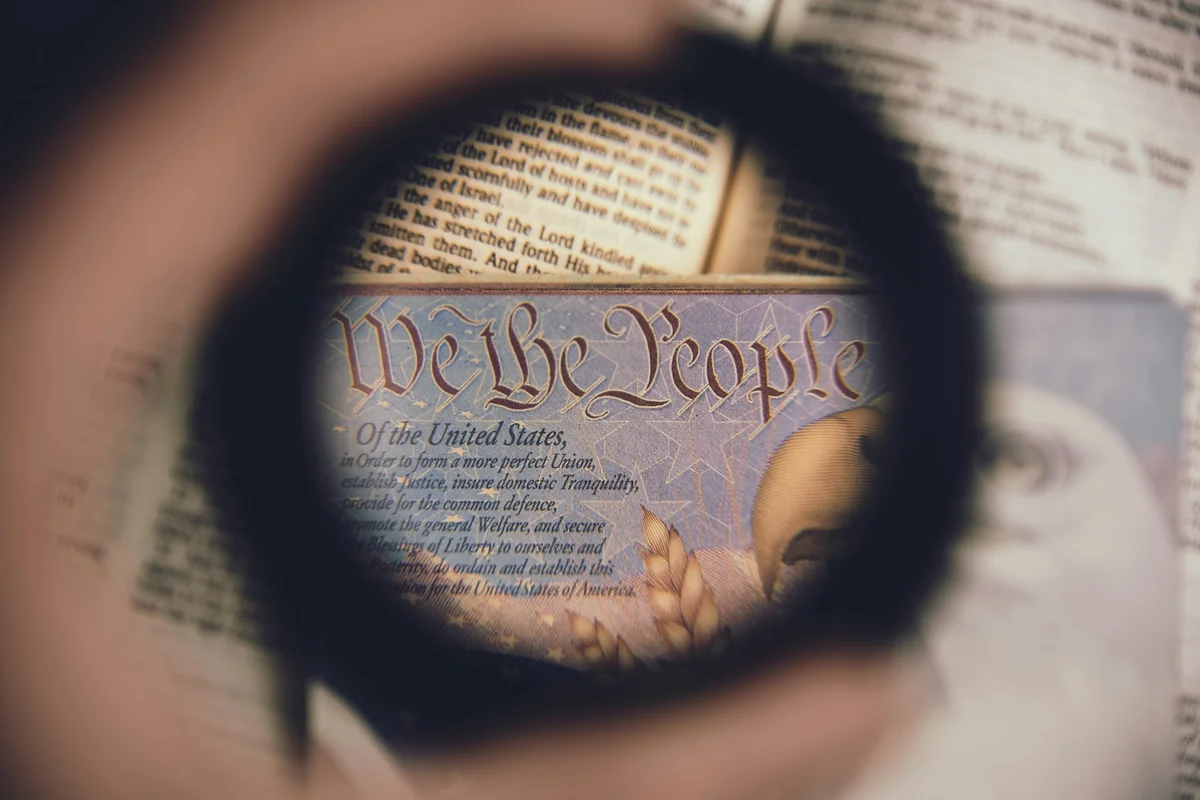
Looking through the historical telescope, one can clearly trace the path that the Democratic Party has carved across American history. From the Trail of Tears under Andrew Jackson, to slavery, secession, the Civil War, the rise of the Ku Klux Klan, Jim Crow laws, segregation, and the long resistance to civil rights, a recurring pattern emerges. In more recent decades, we can most certainly see the Democratic Party’s unequivocal role in the majority of the nation’s most divisive political and social conflicts, including the civil rights struggles of the 1960s, the Occupy Wall Street movement, Black Lives Matter unrest, ANTIFA activism, calls to defund the police and ICE, and other atrocities of political and civil anarchy. The names, slogans, and methods may evolve with time, but the Democrats’ underlying pursuit of power, dependency, division, and political control often appears remarkably familiar to those willing to examine the historical record with open eyes and intellectual honesty.
And that brings us back to the central vital lesson: Historical patterns are the best indicator of future behavior. A nation that forgets its history loses its ability to recognize those patterns. A nation that recognizes them gains the power to shape its future. History is not merely a collection of dates and dusty textbooks. It is a roadmap. It teaches us who fought for liberty, who resisted it, who defended constitutional principles, and who sought to undermine them. Most importantly, it teaches us to recognize recurring political habits before they become recurring political tragedies.
Useful Idiots and the Antidote
Joseph Stalin reportedly referred to those who naively and unknowingly advanced his destructive agenda, often to their own demise, as “useful idiots”. Today, we can see a similar pattern among segments of our own society who have been manipulated, misled, and gaslighted by the Democratic Party Machine. Consequently, political discussions among such useful naives often become driven by emotion rather than reason. That in turn, propagates anger, tribalism, and hostility rather than thoughtful debate. When passion replaces principle, and outrage replaces critical thinking, common sense becomes the first casualty.
The antidote to becoming a “useful idiot” is not tribalism. It is knowledge. It is historical literacy. It is the willingness to examine facts honestly, regardless of how uncomfortable they may be. Only an informed citizenry can separate truth from propaganda and emotion from reason, thereby preserving both liberty and the constitutional foundations upon which this nation was built.
Why I Wrote Common Sense 2.0
That is precisely why I wrote Common Sense 2.0: A BBB (Big Beautiful Book). Its purpose is not merely to recount history, but to awaken minds, inspire hearts, and encourage Americans to think critically about the future of the Republic we have inherited. It seeks to connect historical dots that too often remain disconnected and to empower ordinary citizens with the knowledge necessary to make informed decisions in the voting booth and beyond.
The future of America will not be determined by politicians alone. It will be determined by an informed and courageous voting base that understands its history, recognizes dangerous patterns, and refuses to surrender its constitutional liberties.
The Radical Republicans of the Reconstruction Era understood that determined patriots can change the course of history. The challenge before us today is whether the new generations of Americans possess that same courage, conviction, and commitment to truth. The future is not shaped by those who ignore history. The future belongs to those who learn from it.
A Call to Restore America

Common Sense 2.0, A BBB is a call for a new generation of Radical Republicans, not to radically change America, but to radically restore America. To restore constitutional government and ensure that responsibility, accountability, transparency, and common sense once again guide the policies, priorities, and actions of those entrusted with governing our Republic.
In the end, historical patterns are the best indicator of future behavior. History has already written the warnings. The question before us is whether we will pay attention to these warnings, learn from them, and summon the courage to change the course of our nation’s future accordingly.