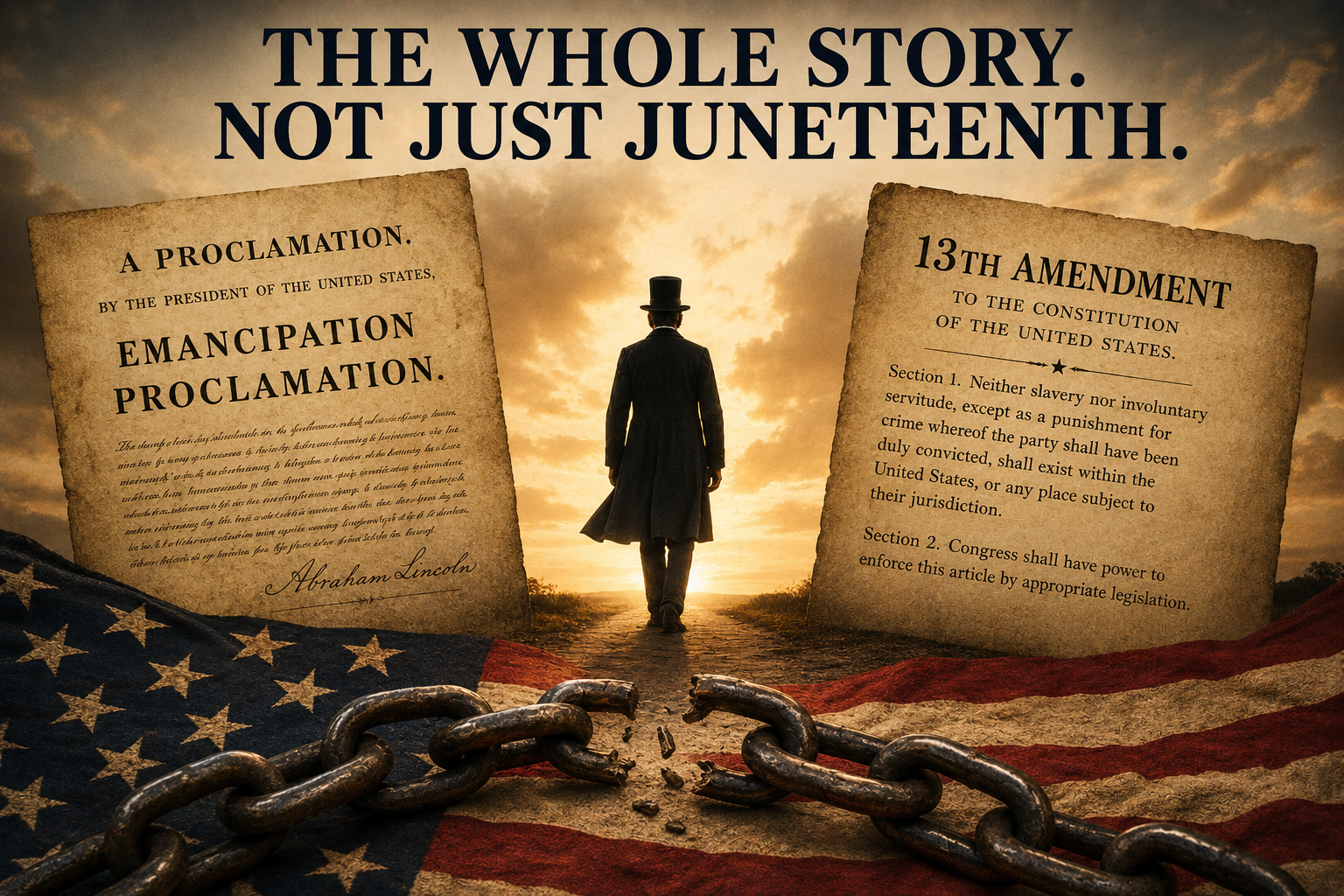
Why America’s Newest Federal Holiday Celebrates an Important Event, But Not the Most Important Event in the Story of Slavery’s Abolition
By Sassan Kaveh, M.D.
America’s newest federal holiday spotlights Juneteenth — but the full story of Juneteenth and the Emancipation Proclamation stretches far beyond one June day in Galveston.
Every magician knows the secret. The trick is rarely what the audience sees. The trick is what the audience is prevented from seeing. One hand captures your attention while the other quietly performs the act that matters. The audience walks away believing it has witnessed the entire performance, unaware that the most important part happened with the opposite hand.
Juneteenth and the Emancipation Proclamation: An Important Day, Not the Whole Story
That is why I find myself increasingly uncomfortable with Juneteenth. Not because the event itself was unimportant. Quite the opposite. The liberation of enslaved Americans in Texas was a historic moment worthy of remembrance. Freedom is always worth celebrating. The arrival of Union troops in Galveston on June 19, 1865, and the enforcement of emancipation for approximately 250,000 enslaved people represented a triumph of liberty over oppression. That event deserves a place in our national memory.
What concerns me is not the celebration itself. What concerns me is the increasingly common tendency to treat Juneteenth as though it represents the entire story of slavery’s abolition in America. It does not. It represents an important but small chapter, and definitely not the whole book.
Imagine celebrating the moon landing without mentioning NASA. Imagine commemorating V-J Day without mentioning World War II. Imagine celebrating the final touchdown of the Super Bowl while pretending the first fifty-nine minutes never happened. The ending matters, but the ending only makes sense when understood within the larger story that produced it.
Juneteenth commemorates the final enforcement of emancipation in one part of the country. The destruction of slavery, however, was the result of a far larger struggle involving political courage, constitutional action, military victory, and extraordinary sacrifice by the Union cause, led by Lincoln and the Republican Party. By focusing almost exclusively on June 19, 1865, the modern narrative risks pushing into the shadows the events, leaders, sacrifices, and ideas that made that day possible in the first place. At the same time, it conveniently veils the historical memory of the Democratic South, whose defense of slavery, embrace of secession, and rebellion against the Union brought civil war and devastation upon the American people.
The Emancipation Proclamation: January 1, 1863
The story begins not in Texas in 1865, but in Washington, D.C., on January 1, 1863, when President Lincoln issued the Emancipation Proclamation. It was a very clever wartime measure designed to weaken the Confederacy, strengthen the Union war effort, discourage foreign support for the South, and place the cause of emancipation at the center of the Civil War. Recognizing that an executive order might not survive the war, Lincoln later championed the Thirteenth Amendment to abolish slavery permanently through the Constitution.
The story of Emancipation Proclamation has more historical significance than most Americans are ever led to believe. It is irrefutably the most consequential executive order by a US president in our history. It profoundly changed the moral, political, military, constitutional, and historical trajectory of the United States. It transformed the Civil War from a conflict focused primarily on preserving the Union into a struggle increasingly centered on human freedom. It undermined the economic foundation of the Confederacy, encouraged enslaved people to seek freedom behind Union lines, discouraged Britain and France from supporting the Southern rebellion, and authorized the enlistment of Black soldiers into the Union military.
Most importantly, by using Lincoln’s war powers as the head of the military, it was the first time a US president was able to take such a bold action against not just preventing the spread of slavery but to outright abolish it. Nearly 200,000 Black Americans would eventually serve in Union uniform, fighting not merely for their country but for their own freedom and the freedom of their future generations.
The Beginning of Slavery’s Destruction
The proclamation was not the end of slavery, but it was the beginning of slavery’s destruction. Then the commonsense question would be: If the most consequential executive order in American history was issued on January 1, 1863, and if it launched the process that ultimately destroyed slavery, why is that date largely ignored while June 19, 1865, receives federal recognition? It now becomes quite clear that the answer lies under the shadow of political manipulation by the Democratic Party Machine.
The institution of slavery that had existed in North America for centuries did not collapse because of a symbolic declaration alone. It collapsed because Union armies enforced that declaration across the South. It collapsed because hundreds of thousands of white Republicans as the Union soldiers marched, fought, bled, and died to preserve the nation and defeat the Confederacy.
It collapsed because Abraham Lincoln and the Republican Party possessed the courage and conviction to selflessly defend the American Union in a war that many believed would determine not only the survival of the nation, but the future of the great American experiment in self-government. That historical reality is difficult to separate from the political realities of not only that era but also today’s.
The Confederacy was not a politically neutral entity. It was dominated by Democrats. Its leaders openly defended slavery as it was fundamental to their social, economic, and political institutions. The Republican Party, founded in opposition to the whole institution of slavery, elected Abraham Lincoln as their first fearless leader, prosecuted the war, advanced emancipation, and ultimately pushed through the constitutional amendment that permanently abolished slavery.
These facts are not partisan talking points. They are historical truths. Yet, modern discussions of slavery and emancipation often seem strangely detached from these realities.
Many Americans on the left may identify Juneteenth but cannot explain the purpose of the Emancipation Proclamation. Many of them may know June 19, 1865, but cannot identify January 1, 1863. Many have heard of General Gordon Granger’s arrival in Galveston but know little about the hard Republican’s constitutional battle against the Democrats that culminated in the Thirteenth Amendment. Many celebrate the final chapter while remaining unfamiliar with the struggles.
Juneteenth in Context: Only 8% of the Enslaved
That should concern anyone who values historical literacy. By the time Union troops arrived in Galveston, Texas, the Confederacy had already suffered military collapse. Richmond, as the capital of Confederacy, had already fallen. General Robert E. Lee had unconditionally surrendered at Appomattox, Virginia.
More than 3 million enslaved people throughout Confederate territory had already been liberated as Union armies advanced across the South. Also, about half a million slaves were freed from the Border States, even though the Emancipation legally excluded them.
For example, Maryland, Missouri, and West Virginia had abolished slavery on their own through state-level legislation between late 1864 and early 1865. However, Kentucky and Delaware still legally held tens of thousands of people in bondage. Slavery was not abolished there until the 13th Amendment was officially ratified six months later, on December 6, 1865.
Texas remained an exception largely because of its geographic isolation and limited Union military presence. Juneteenth marks the enforcement of a freedom that had already been proclaimed more than two years earlier and was rapidly becoming a reality across the defeated Confederacy. It was not the date freedom was created. The enslaved people of Texas were legally freed by the Emancipation Proclamation on January 1, 1863. In practical terms, however, many did not learn of or experience that freedom until Union troops arrived in June 1865. In reality, June 19, 1865, was neither emancipation nor abolition of slavery, it was merely an enforcement of what had already been the Republican government’s official policy for two and a half years.
Again, that does not diminish the significance of Juneteenth. It simply places it in context. Out of the 4 million enslaved blacks in the Southern States and the Border States, the 250,000 freed slaves on June 19, 1865, only represents eight percent of all the freed slaves.
Five Dates That Deserve Remembrance
That begs the bigger question as to why Democrats try so hard to make Juneteenth the centerpiece of our national remembrance while other dates receive little to no recognition.
If Black and non-Black Americans were honestly searching for a day to commemorate the destruction of slavery, there are a few other obvious candidates:
January 1, 1863, marks the courageous issuance of the historical Emancipation Proclamation by President Lincoln, the moment the first US president ever formally committed the federal government to emancipation, by using his war powers.
December 6, 1865, marks the ratification of the Thirteenth Amendment, the moment, by persistence of staunch Republicans in congress, slavery became unconstitutional throughout the entire United States and its territories.
November 6, 1860, marks the election of President Abraham Lincoln, the liberator of the slaves, the savior of the Union, and a martyr for the cause of freedom.
April 9, 1865, marks the unconditional surrender of the Confederate Army, bringing the pro-slavery Democratic rebellion to its military end. It was also the decisive turning point that preserved the Union, paved the way for the permanent abolition of slavery, and restored the promise of one nation, indivisible, under one Constitution.
April 14, 1865, marks the day Lincoln gave his life in service to the nation he had fought to preserve, leaving behind a reunited Union and a constitutional revolution that would forever alter the course of American history.
The first date marks the beginning of slavery’s destruction. The second marks its permanent constitutional death. The third marks the moment the American people chose a leader willing to confront the greatest moral and political crisis of their age. The fourth marks when the Confederacy surrendered, making Union victory and nationwide emancipation inevitable. The fifth marks the moment the man who preserved the Union and made constitutional abolition possible paid the ultimate price. Yet neither became a federal holiday. Instead, President Joe Biden chose a date commemorating the final enforcement of emancipation in Texas, dismissing all the struggles the Republican North went through to get there.
The Democratic Party’s Sleight of Hand
Supporters of Juneteenth often argue that the holiday emerged organically from generations of celebration within some local Black communities, and there may be some truth to that observation. But be that as it may, there is still the question of who has been pushing those local black communities to just focus on the freedom of only eight percent of the enslaved people. What about the rest of ninety two percent? As it was anticipated, the proclamation could only be enforced where Union armies advanced. Thus, emancipation naturally spread as the Union won military control of Confederate territory.
Furthermore, choosing to celebrate Juneteenth alone does not answer the more profound question: Why did successive Democratic leaders choose to elevate this particular date to federal status while allowing the nation’s attention to drift away from the defining milestones that made emancipation possible. Those include: the election of Lincoln, the Emancipation Proclamation, the Union’s victory over the Confederacy, and the ratification of the Thirteenth Amendment? This is when the sleight of hand trick of the Democratic Party comes in.
If a political party had once defended an institution that history now universally condemns, would we trust that party to become the sole curator of how that history is remembered? Would we allow it to choose which dates are emphasized, which events are highlighted, and which facts quietly fade into the background? Most people would instinctively answer no. Yet that is precisely why we should remain skeptical whenever Democrats’ historical memory of slavery era becomes politically curated.
One of the greatest political tragedies in modern history is that the Democratic Party survived the Civil War at all. Few political organizations in history have led a rebellion against their own nation, plunged their country into four years of bloody civil war, suffered a complete military defeat, surrendered unconditionally, and then gone on to dominate the political landscape of the very nation they once sought to tear apart. Yet that is precisely the foolhardy story of the Democratic Party. Most such movements disappear into history books, remembered as cautionary tales rather than viable political parties. The Democratic Party is one of the bizarre exceptions.
That reality deserves far more attention than it receives. The Civil War was not simply a disagreement over policy. It was the bloodiest conflict in American history. More than 750,000 of fellow Americans died during the Civil War, more than all other wars in history, combined. Entire regions were devastated. Families were destroyed. The Union itself nearly ceased to exist. At the heart of that catastrophe stood the Southern Democratic political establishment, which chose secession rather than accept the results of a constitutional presidential election. That is not partisan rhetoric. It is a tragic sequence of historical events.
Yet over 160 years later, there has never been anything resembling institutional reckoning. The Democratic Party has tried to rebrand itself many times, but it has never squarely confronted the skeletons in its closet, its role in defending slavery, leading the Confederacy, and helping ignite the Civil War, among many others. Nations often expect truth commissions, official acknowledgments, or historical accountability after great national tragedies. America has never experienced anything comparable regarding the political origins of the Civil War.
By placing Juneteenth front and center, Democrats divert attention away from that larger history and recast themselves as champions of emancipation and friends of abolition, a portrayal that stands in sharp contrast to the historical record.
History Without Accountability Is Mythology
When we teach about the First or Second World War, we do not merely commemorate isolated battles. We ask tough questions, such as who started the conflict, what ideas fueled it, who defended freedom, who threatened it, and what lessons future generations must learn from them. We prosecute the aggressors. We embrace the defenders. We analyze the causes as carefully as the consequences. That is how serious nations learn from history.
Yet when it comes to America’s own Civil War, the conversation often becomes strangely uncomfortable. We discuss the battles and not the war. We discuss Gettysburg. We discuss Antietam. We discuss Appomattox. We discuss Juneteenth. But far less frequently do we ask the larger questions such as: Which political party led the nation into this catastrophe, and why? Who truly were the perpetrators and what ever happened to them? Did the aggressor ever pay any reparation like they did in WWI and WWII? What lessons should future generations learn from that war?
History without accountability is not history. It is mythology. Perhaps that is why the Civil War still feels like an unfinished conflict. The armies surrendered in 1865, but the battle over historical memory continues today. Until America is willing to confront the entire story of the Civil War, we should not be surprised that our nation continues to struggle with questions of race, identity, and reconciliation. No nation can fully reconcile with its past that it refuses to examine honestly.
While returning from a recent trip to Europe on the airplane, I watched a movie about the Nuremberg Trials. What struck me most was not simply the prosecution of the top generals but the larger purpose of those proceedings. They established an authoritative historical record, assigned legal responsibility to those found guilty, and helped lay the groundwork for reconstruction and reconciliation. The idea was that the war needed to end in the courtroom. The trials did not erase history; they forced a nation to confront it openly so that the world would finally have a closure.
That experience led me to a provocative question. Has America ever fully confronted the Civil War with the same determination to establish a shared historical reconciliation? We have preserved battlefields, written countless books, and erected monuments, but we continue to argue over the conflict’s meaning and legacy. Whether one agrees or disagrees with the idea, perhaps what America still lacks is not another holiday but a renewed national effort to examine the Civil War honestly, acknowledge the roles played by all sides, and preserve an accurate historical record for future generations. We need closure in the courtroom. We need “Richmond Trials”. Even though the individual generals are far gone, we still have DNC and RNC well and alive. The heads of the DNC can legally and politically be prosecuted for the atrocities that their party caused for the last 2 centuries. Under the constitution, there is no statute of limitation for treason.
The Danger of Remembering Only One Chapter
The danger is not that we remember Juneteenth. The danger is that we remember Juneteenth and forget everything else. Every magician knows that the secret of the illusion lies not in what the audience sees but in what it is encouraged not to notice. Whenever Democrats’ memory becomes narrowly focused on one chapter while the larger story quietly fades from view, citizens have the solemn duty to pause and ask a simple but essential question: Are we preserving history in its entirety, or are we remembering only the parts that are just politically convenient to the Democratic Party?
That is why the choice of a national holiday is never merely symbolic. It is an act of historical storytelling. It determines which events are celebrated, which heroes are remembered, which sacrifices are honored, and, just as importantly, which chapters quietly fade from public memory. Every nation teaches history to its children. The real question is whether that history is complete or selectively curated.
History should illuminate the whole truth, not merely the most politically convenient chapter. A free people should never fear the complete story of their own history, because truth is never the enemy of liberty. On the contrary, truth is liberty’s strongest ally.
Why I Wrote Common Sense 2.0
That conviction was the most important impetus for me writing Common Sense 2.0: A BBB (A Big Beautiful Book). As an immigrant, a physician, and an American who owes everything to this remarkable nation, I believe our country can only heal after we first make an honest diagnosis of what has divided us. Physicians do not cure disease by ignoring its cause, and nations do not heal by forgetting their past. They heal by confronting it, fully, honestly, and courageously.
My hope is not to reopen old wounds, but to close them properly. Not by forgetting our past, but by understanding it. Not by dividing Americans, but by reminding us that truth is the only solid foundation upon which genuine unity can ever be built.
The Civil War ended in 1865. The struggle over its history continues to this day. The question is no longer who won the war. The real question is what we have learned from it. A nation that forgets the truth of its past will eventually lose the wisdom to protect its future.
Yet today, our challenge extends beyond the unfinished legacy of the Civil War. We also risk forgetting the hard-earned lessons of the twentieth century, the devastation wrought by socialism, the oppression of communism, and the decades-long struggle of the Cold War against totalitarian ideologies. Every generation is tempted to believe it is immune from the mistakes of the past. History teaches exactly the opposite. Ideas that once brought misery to millions often return under new names, new slogans, and more deceiving packaging. That is why historical memory matters so profoundly.
History is the memory of a nation. Change its memory, and eventually you change the nation itself. That is the warning I hope readers will carry with them, not only from this article, but also from my book, Common Sense 2.0. My purpose is not merely to revisit the bitter past, but to encourage Americans to examine it honestly, think critically, and preserve the principles of liberty, constitutional self-government, and equal justice that have made the United States the freest and most prosperous nation in human history.
Read the Full Story in Common Sense 2.0
If this perspective challenged the way you think about American history, that is exactly the point. I explore these questions — and many more about liberty, memory, and the future of our republic — in far greater depth in my book, Common Sense 2.0: A Big Beautiful Book.
Get your copy of Common Sense 2.0 here →
If it resonated with you, share this article with someone who values the whole truth, and add your voice in the comments below. History is the memory of a nation — help keep it complete.
Frequently Asked Questions
What is the difference between Juneteenth and the Emancipation Proclamation?
The Emancipation Proclamation (January 1, 1863) was President Lincoln’s wartime order that began the legal destruction of slavery in Confederate territory. Juneteenth (June 19, 1865) marks the day Union troops enforced that freedom in Galveston, Texas — more than two years later.
What did the Emancipation Proclamation actually do?
It declared enslaved people in Confederate territory free, shifted the Civil War toward a struggle over human freedom, undermined the Confederate economy, discouraged Britain and France from supporting the South, and authorized Black soldiers to serve in the Union Army.
When did slavery legally end in the United States?
Slavery became unconstitutional throughout the United States with the ratification of the Thirteenth Amendment on December 6, 1865.
What share of enslaved people were freed on Juneteenth?
The roughly 250,000 people freed in Texas on June 19, 1865 represented about eight percent of the roughly 4 million enslaved people across the Southern and border states.