
By Dr. Sassan Kaveh
Presidential health is not a private medical matter — it is a national security variable, and the United States still relies almost entirely on the honor system to learn whether the most powerful person on earth is fit to serve. As a physician, I find that arrangement indefensible.
I have practiced internal medicine for more than three decades. I have delivered hard diagnoses to patients and families, and I know where the boundary of medical privacy lies for every citizen. But the presidency is not a private station. When a single individual commands the nuclear arsenal, the question of presidential health stops being personal and becomes constitutional.

Why Presidential Health Is Not A Private Matter
The argument is simple and, once stated, difficult to refute. The voters are the president’s employer. An employer entrusting someone with command of the armed forces, the veto, and the pardon power has a legitimate interest in whether that person can think clearly under pressure — today and for the duration of the term. Concealment does not protect the patient; it disenfranchises the country.
Privacy For Citizens, Transparency For Power
This is not a call to strip any citizen of medical privacy. It is the opposite: privacy is the citizen’s right precisely because the citizen wields no public power. The exchange rate has always been understood in principle — seek the office, accept the scrutiny. Our failure has been enforcing it.
Consider what the office actually demands. A president may be awakened at three in the morning to evaluate an ambiguous missile warning, weigh retaliation, and issue irreversible orders within minutes. Cognition, judgment, stamina, and freedom from impairing medication are not courtesies we may hope the officeholder possesses — they are the functional requirements of the job. A nation that drug-tests its train conductors but accepts a press release about its commander-in-chief has its priorities exactly inverted.
The question grows more urgent, not less. Recent decades have given us the oldest presidents in American history, and medicine is unambiguous about what advancing age does to the statistical likelihood of cardiovascular disease, malignancy, and cognitive decline. None of this disqualifies any individual — I have eighty-year-old patients sharper than men half their age. But probability is not partisanship, and a country electing septuagenarians and octogenarians to its most demanding office has a proportionally greater need for honest, verified answers about presidential health.
A Century Of Concealment: Wilson, Roosevelt, Kennedy
Woodrow Wilson, 1919
After a massive stroke in October 1919, Woodrow Wilson was incapacitated for months while his wife Edith and his physician controlled access to the Oval Office and filtered every document he saw. The country was never told the truth. Historians still debate who, functionally, was running the executive branch.
Franklin Roosevelt, 1944
FDR sought a fourth term while his physicians privately understood his cardiovascular disease was grave. The public saw retouched confidence; the man had eighty-two days to live when his final term began. The voters of 1944 were choosing a president — they were not told they were also choosing his successor.
John F. Kennedy, 1960
Kennedy’s campaign flatly denied he had Addison’s disease — an adrenal insufficiency requiring steroid treatment — though the diagnosis was real and the denials were studied. The image of vigor was a marketing product.
What The Public Was Told Instead
In each case, the machinery of reassurance worked flawlessly. Wilson’s physician described the stroke that paralyzed a president as exhaustion requiring rest. Roosevelt’s team announced him fit for four more years. Kennedy’s campaign turned a chronic endocrine disease into a story about youthful vigor. The official bulletins were not merely incomplete; they were instruments, drafted to manage the public rather than inform it. And in every instance the truth emerged only when it no longer mattered — from memoirs, archives, and medical records unsealed decades later.
Three different parties, three different eras, one constant: when disclosure is voluntary, concealment wins.
What The 25th Amendment Does — And What It Cannot Do
Ratified in 1967 after the Kennedy assassination forced the issue, the Twenty-Fifth Amendment finally gave the Constitution a vocabulary for presidential incapacity. Section 3 lets a president voluntarily transfer power — used briefly for routine procedures under anesthesia. Section 4 allows the vice president and a majority of the Cabinet to declare a president unable to serve. It has never been invoked.
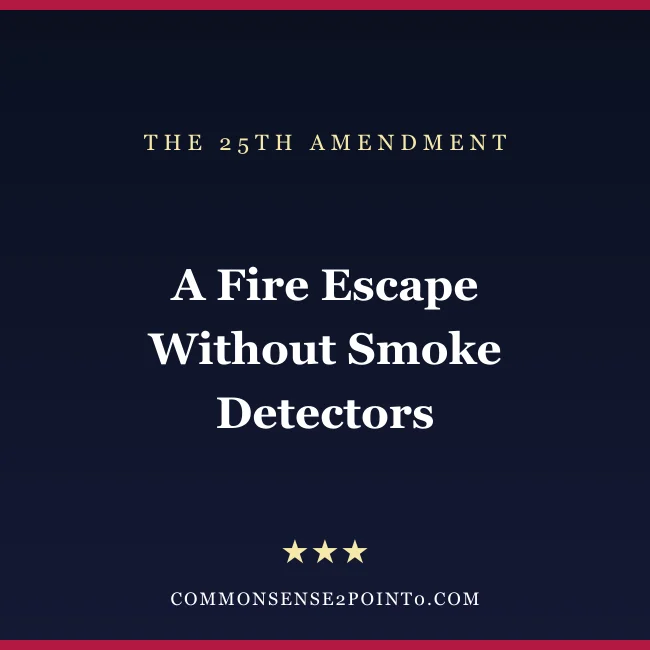
Notice what is missing. The amendment presumes the relevant facts are known. It supplies a remedy for acknowledged incapacity while providing no mechanism whatsoever to discover concealed incapacity. A White House physician answerable to the patient, a Cabinet appointed by the patient, a family with every incentive to protect the patient — that is the entire detection system. The 25th Amendment is a fire escape on a building with no smoke detectors.
Section 4 carries a second, quieter defect: every person empowered to act owes their position, their proximity, and often their future to the very president they would have to declare unfit. We ask the most conflicted people in Washington to perform its most disinterested act. It should surprise no one that in over half a century, they never have.

Presidential Health Disclosure Today: Norms, Not Laws
| Safeguard | Status | The Gap |
|---|---|---|
| Annual physical with public summary | Custom only | Content entirely at the president’s discretion |
| Candidate medical disclosure | Voluntary | No standard, no verification, no penalty for omission |
| White House physician’s report | Serves at the president’s pleasure | Physician’s duty runs to the patient, not the public |
| 25th Amendment, Section 4 | Constitutional, never used | Requires the president’s own appointees to act |
| Independent medical panel | Does not exist | Proposed for decades; never adopted |
Every row reduces to the same flaw: the person being evaluated controls the evaluation. In no other safety-critical occupation — airline pilot, surgeon, nuclear plant operator — would we accept self-certification. For the presidency, we accept nothing else.
The military comparison is the sharpest. Every officer with nuclear responsibilities serves under a personnel reliability program: recurring medical review, medication reporting, psychological screening, and removal from duty at the first unresolved doubt. The men and women who would execute a launch order are continuously certified. The one person authorized to give that order is never examined by anyone he does not employ. We built the pyramid of verification and left off its apex.
A Physician’s Prescription For Transparency
I wrote earlier this year about the questions raised by President Biden’s Stage IV prostate cancer announcement — questions of timing and surveillance that any internist would ask, given that men under continuous executive-level medical care receive the most comprehensive screening on earth. The reaction to that essay confirmed its premise: merely asking how an aggressive cancer surfaces at Stage IV in such a patient was treated as an act of aggression. A healthy republic does not respond to clinical questions with outrage; as I argued in my essay on institutional double standards, outrage is what institutions deploy when they cannot supply answers. The reform I would prescribe is modest: an independent, bipartisan medical panel — physicians with no employment relationship to the White House — conducting and publishing an annual fitness evaluation of the president and of major-party nominees. Not diagnosis by press conference. Not armchair psychiatry. Verified facts, standardized, on the record.
The scope would be narrow by design: a standardized battery covering cardiovascular status, cancer surveillance appropriate to age, medication review with attention to anything cognition-impairing, and validated cognitive screening. The published product would be a fitness determination with supporting essentials — not the full chart, not every private detail, only what bears on capacity to serve. That balance is not novel; it is exactly how aviation medicine has handled pilots for generations. We know how to do this. We have simply exempted the one job where the stakes are highest.

Why This Matters — And Where Common Sense 2.0 Goes Deeper
Some will object that no president would accept such scrutiny. History answers otherwise: officeholders accept exactly as much scrutiny as the public insists upon, and not one ounce more. The disclosure norms we have were not gifts — each one was extracted after a concealment scandal. The question is whether we require the next reform before the next crisis, or after it.
Concealment of presidential health is one chapter in a longer American story I examine in Common Sense 2.0 — A BBB (Big Beautiful Book): the story of institutions that demand trust while exempting themselves from verification. A free people cannot consent to what it is not permitted to know — about its history, its government, or the health of the hand on the nuclear codes. The remedy, as always, begins with citizens willing to ask plain questions and decline scripted answers. You can read about my own path from Iran to American medicine on the About page.
Ask The Plain Questions — Order Your Copy
If you believe transparency is a duty of power and not a courtesy, order Common Sense 2.0 on Amazon and join our Community of Patriots through the newsletter at commonsense2point0.com.
Trust is medicine’s currency, and a republic’s too. Neither survives long where verification is forbidden.