By Dr. Sassan Kaveh
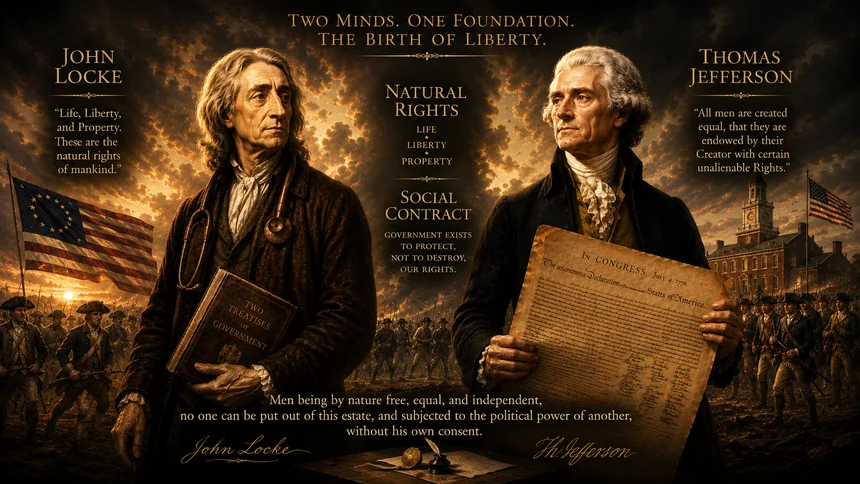
Natural rights are the rights you possess simply because you are a human being — life, liberty, and the fruits of your own labor. Governments do not grant them and therefore may not revoke them; legitimate governments exist only to secure them. That single idea, carried from John Locke’s study to Thomas Jefferson’s writing desk, is the entire American premise.
What Are Natural Rights — and Who Grants Them?
Ask a modern law student where rights come from and you will likely hear about statutes, courts, and evolving social consensus. The Founders would have called that answer not merely wrong but dangerous — because whatever a legislature grants, a legislature can repeal.
The doctrine of natural rights inverts the relationship. Rights precede the state. They are, in Jefferson’s formulation, the endowment of the Creator; in Locke’s, the law of nature discoverable by reason. Either way, government arrives afterward, as a hired guard — and a guard who begins confiscating what he was hired to protect has broken the contract that employs him.
I grew up in a country where rights were whatever the regime said they were on a given morning. The distinction between granted privileges and natural rights is not a seminar question to me. It is the difference between the two halves of my life.
The Physician’s Analogy
In my consulting room, I do not grant a patient his heartbeat. I find it, I measure it, and I am obligated to protect it. The heartbeat was there before I walked in, and my license exists for its sake — not the other way around. That is precisely the relationship the Founders established between government and natural rights: the state is the physician of last resort, hired to protect what it did not create and may never claim to own. A government that begins to speak of rights as its own generous dispensations has committed the political equivalent of malpractice.
From Locke’s Treatise to Jefferson’s Declaration
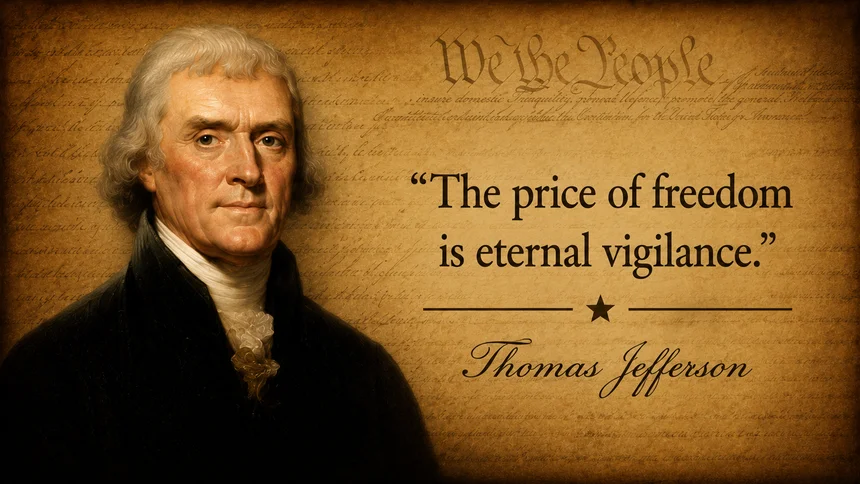
John Locke published his Two Treatises of Government in 1689, arguing that men are born “in a state of perfect freedom” and that no one may be “subjected to the political power of another, without his own consent.” Eighty-seven years later, Thomas Jefferson compressed Locke’s philosophy into the most consequential paragraph in the English language. Set them side by side:
| John Locke (1689) | The Declaration of Independence (1776) |
|---|---|
| “Life, liberty, and estate” as every man’s natural property | “Life, Liberty and the pursuit of Happiness” |
| Government legitimate only by consent | “Deriving their just powers from the consent of the governed” |
| A people may dissolve a government that betrays its trust | “It is the Right of the People to alter or to abolish it” |
The Declaration’s full text at the National Archives repays a slow reading. So does the Stanford Encyclopedia’s treatment of Locke’s political philosophy, for those who want the scholarship beneath the slogans.

Give Me Liberty: The Voices That Carried Natural Rights to War
Ideas do not field armies; men persuaded by ideas do. In March 1775, Patrick Henry stood in a Richmond church and ended the argument: “Give me liberty, or give me death!” That sentence is the doctrine of natural rights stripped to its fighting weight — the assertion that a life without liberty is not a lesser bargain but no bargain at all.
Adams’s Caveat
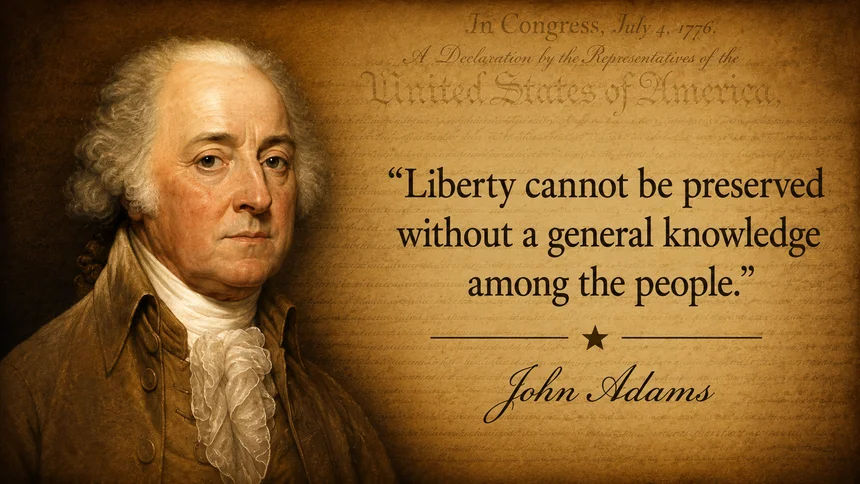
John Adams added the load-bearing qualifier. “Our Constitution was made only for a moral and religious people,” he wrote in 1798. “It is wholly inadequate to the government of any other.” Natural rights impose natural duties — self-restraint, honesty, the rearing of children who can govern themselves. A people that abandons the duties will not long keep the rights. As a physician I would put it clinically: rights are the patient’s vital signs, and virtue is the metabolism that sustains them.
Why Natural Rights Are Under Pressure Today
Every generation produces officials who find natural rights inconvenient, because a right that precedes government is a permanent ceiling on their ambitions. The modern pressure campaign is familiar to anyone watching closely:
- Reframing rights as grants. When speech becomes a “privilege” conditioned on approved viewpoints, the First Amendment has been quietly repealed in spirit.
- Substituting group entitlements for individual rights. Natural rights attach to persons, not categories; tyrannies always prefer to deal in categories.
- Medicalizing and managing dissent. I wrote about the political weaponization of medical narratives in my analysis of Biden’s prostate cancer diagnosis — the habit of concealment that treats citizens as patients to be managed rather than adults to be informed.
- Teaching children their inheritance is shameful. A generation that believes its founding was illegitimate will surrender its founding protections without a fight.
The Bill of Rights does not create one single right. Read it again with that in mind: every clause restrains the government, not the citizen. The Founders knew exactly which party to the contract needed watching.

Recovering First Principles
The recovery of natural rights begins where Locke began: with the sober recognition that you were born free, that your rights are not Washington’s to ration, and that consent withdrawn is the most powerful instrument a free people holds — exercised lawfully, at the ballot box, with spine and clarity and without a single broken window.
It continues at the kitchen table. Children are not born knowing that their rights precede their government; every tyranny in history has depended on that ignorance, and every free generation has been one failed civics lesson away from supplying it. Teach your children Locke’s sequence — rights first, consent second, government third — and you have inoculated them against the oldest fraud in politics. Natural rights survive exactly as long as the people who hold them can explain where they came from.
Common Sense 2.0 — A BBB (Big Beautiful Book) traces this lineage from Locke through Jefferson to the present hour, because Americans cannot defend a premise they were never taught. Order the book on Amazon, explore frequently asked questions about the project, and join our community of patriots through the newsletter below.
Your rights are older than your government. Any official who suggests otherwise has told you everything you need to know about his plans for both.